

How Institutional Capital Partners Cut Diligence Burden With Vetted Deal Flow
Finding investable opportunities is difficult. Determining which opportunities deserve your team’s time is harder.
For Partners, Managing Directors, CIOs, and Principals across private equity firms, family offices, sovereign wealth funds, UHNW investment platforms, and institutional banks, the challenge is rarely a lack of potential deals. The challenge is fragmented sourcing, incomplete information, cross-border complexity, and an overwhelming diligence workload.
Your team can spend weeks reviewing opportunities that fail to meet the mandate, lack credible documentation, or carry risks that should have been identified before senior investment professionals became involved.
A more disciplined model begins earlier.
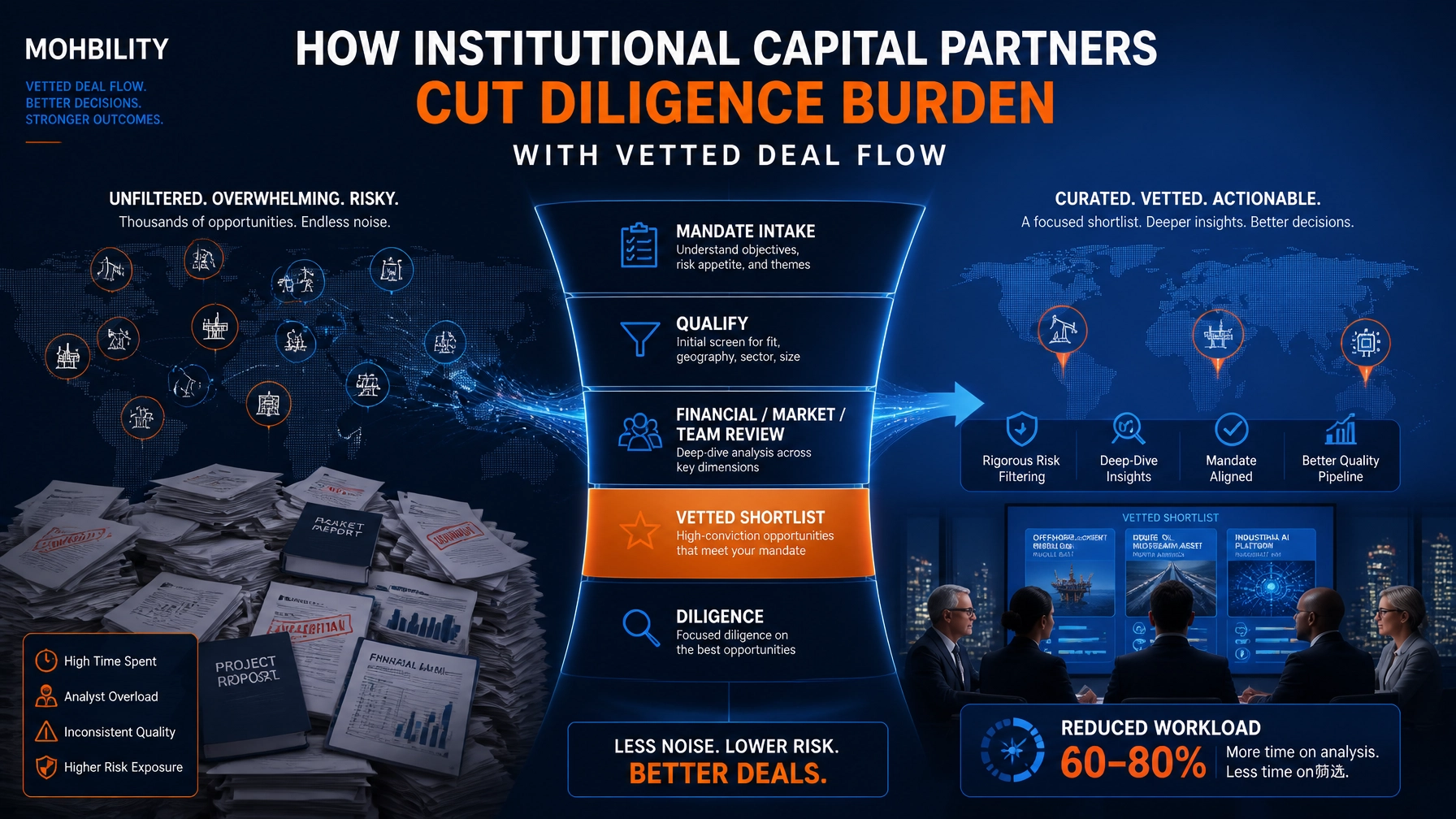
Vetted deal flow does not replace your investment committee, legal counsel, or technical experts. It ensures they spend more time on qualified opportunities and less time filtering noise.
The Diligence Burden Starts Before Due Diligence
Institutional capital partners often describe diligence as a transaction-stage activity. In practice, the burden begins at the moment an opportunity enters the pipeline.
Every new deal may require your team to assess:
- Strategic fit with the investment mandate
- Ownership and capitalization structure
- Financial performance and quality of earnings
- Market size, competitive positioning, and growth drivers
- Management capability and governance
- Regulatory, tax, political, and foreign-exchange exposure
- Technology maturity, cybersecurity, and data governance
- Energy, commodity, infrastructure, or supply-chain risks
- Potential synergies with existing portfolio assets
- Availability and reliability of supporting documentation
The problem is compounded by inconsistent deal submissions. One opportunity may arrive with a robust data room. Another may include only a short presentation and informal financial estimates.
This inconsistency creates unnecessary friction. Senior decision-makers are pulled into preliminary screening. Analysts spend time chasing missing documents. Advisors duplicate work across multiple stakeholders. Opportunities lose momentum before their strategic value is fully understood.
The solution is not simply to review more deals.
It is to improve the quality, structure, and relevance of deal flow before it reaches your core diligence team.

Why Market Coverage Alone Is Not Enough
The market coverage gap is substantial. Research published by Axial cites Sutton Place Strategies data showing that the median private equity firm covers approximately 17.6% of relevant deal flow, while even top-quartile firms reach only about 27.5%.
That means many institutional investors are not choosing between every relevant opportunity. They are choosing from a partial and highly intermediated view of the market.
This matters particularly in fragmented sectors and lower-middle-market transactions, where relevant opportunities may be distributed across:
- Boutique investment banks
- Regional M&A advisors
- Specialized brokers
- Founder and operator networks
- Local partners in emerging markets
- Industry associations
- Corporate development teams
- Direct owner relationships
- Private or lightly marketed processes
The result is a dual problem:
- You may miss attractive opportunities before they are visible to your team.
- You may spend too much time evaluating opportunities that were never a fit.
Vetted deal flow addresses both problems by combining broader sourcing with sharper qualification.
What Vetted Deal Flow Should Actually Mean
“Vetted” should never be a vague marketing term. It should describe a transparent, documented process.
A credible pre-screening framework should clarify:
- Mandate alignment: Does the opportunity fit your geography, sector, stage, ticket size, ownership preference, and return objectives?
- Commercial rationale: Is there a defensible market thesis supported by evidence?
- Financial visibility: Are revenue, margins, cash flow, debt, and capital requirements sufficiently documented for an initial review?
- Management quality: Is the leadership team capable of executing the stated growth plan?
- Risk exposure: Have material regulatory, political, operational, legal, technology, and market risks been identified?
- Transaction pathway: Is there a realistic route to negotiation, financing, closing, and post-transaction value creation?
- Information readiness: Can the sponsor access the documents and stakeholders required for the next diligence stage?
This process is not about creating artificial certainty. It is about establishing decision-useful clarity.
Integrity requires that risks remain visible. Transparency requires that assumptions are labeled. Accountability requires that every recommendation can be traced to the information and analysis supporting it.
A Diagnose-First Model for Institutional Capital
A one-size-fits-all sourcing program rarely works. Your mandate, investment committee process, sector focus, geographic appetite, and risk tolerance are unique.
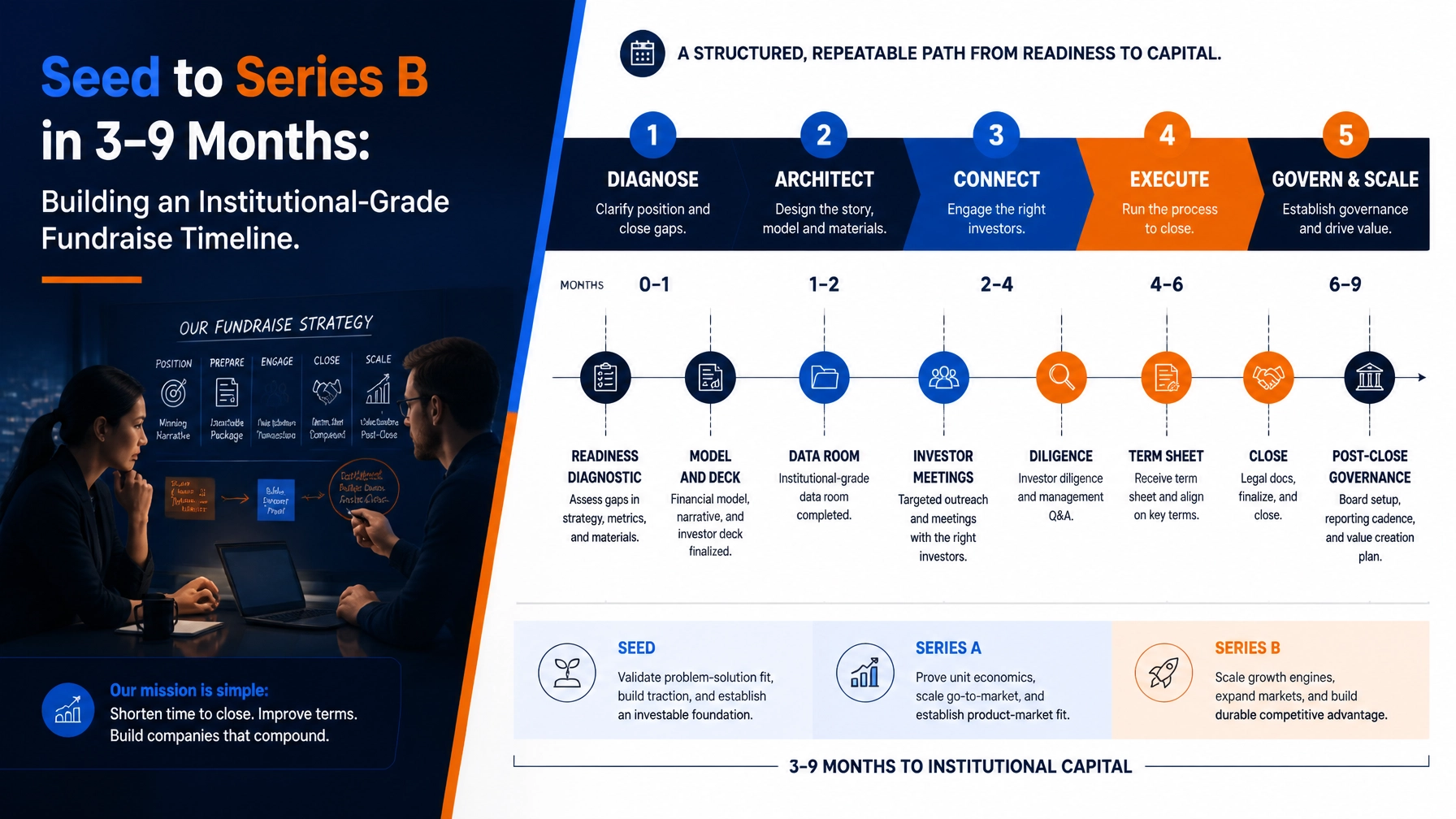
A more effective model follows five connected stages:
1. Diagnose
The first step is a structured Mandate Intake.
Your team should define:
- Preferred sectors and subsectors
- Geographic priorities and restricted jurisdictions
- Investment size and capital structure
- Platform versus add-on preferences
- Target ownership profile
- Return thresholds and investment horizon
- Required governance rights
- Exclusion criteria
- Diligence standards
- Decision-making timeline
A precise mandate reduces irrelevant submissions and gives sourcing partners a clear definition of relevance.
2. Architect
Next, the mandate becomes an operating architecture.
This may include:
- A target-company profile
- A sector and geography map
- A qualification scorecard
- A standardized information request
- A risk taxonomy
- A data-room readiness checklist
- A communication and escalation protocol
- A reporting dashboard for pipeline quality
The objective is to create a repeatable process that improves over time rather than relying on individual relationships or informal judgment.
3. Connect
With the architecture in place, sourcing can extend across global networks and cross-border opportunities.
The focus is not on accumulating names. It is on identifying opportunities where there is a credible fit between the asset, the capital partner, and the transaction pathway.
For institutional investors, this can include direct and intermediated opportunities across:
- Technology and AI
- Energy and crude oil
- M&A and professional services
- LNG
- Emerging markets
A sector-informed network can also surface opportunities before they become broadly auctioned, helping you evaluate assets with greater context and potentially less competitive pressure.
4. Execute
Once an opportunity passes initial qualification, the process should transition seamlessly into formal diligence and transaction support.
That may involve:
- Coordinating management introductions
- Organizing data-room requests
- Supporting financial and commercial analysis
- Mapping regulatory requirements
- Identifying local advisors
- Assessing negotiation dynamics
- Evaluating strategic and operational synergies
- Building an execution timetable
A well-structured data room is particularly important. As explained in Master the Data Room: Company Overview and Introduction Essentials, disciplined information organization can reduce friction and signal operational maturity.
5. Govern & Scale
The relationship should not end at an introduction.
A trusted partner helps you learn from the pipeline:
- Which channels produce the strongest opportunities?
- Which sectors generate the highest conversion rates?
- Where does information quality consistently fall short?
- Which risks are appearing repeatedly?
- How long does each stage take?
- What patterns can improve future sourcing?
This feedback loop creates a more scalable investment capability. It also supports stronger governance, more transparent reporting, and better alignment across investment, operating, and risk teams.
Sector Focus: Where Qualification Matters Most
Technology and AI
Technology and AI opportunities can move quickly, but speed should not eliminate rigor.
Initial screening should examine:
- Product-market fit and customer concentration
- Recurring revenue and retention
- Data rights and governance
- Cybersecurity controls
- Model performance and explainability
- Infrastructure costs
- Dependence on third-party platforms
- Regulatory exposure
- Defensibility and intellectual property
Technology-enabled analysis can help organize large volumes of information, but human judgment remains essential. AI should accelerate review: not obscure accountability.
Energy and Crude Oil
Energy and crude oil transactions require a different diligence lens.
You may need to evaluate:
- Reserves, production, and asset quality
- Contract structures and counterparties
- Transportation and logistics
- Commodity price exposure
- Hedging strategy
- Environmental obligations
- Permitting and regulatory compliance
- Geopolitical risk
- Infrastructure reliability
- Financing and insurance requirements
Specialized commodity trade investment facilitation can help connect market analysis, risk assessment, regulatory guidance, and technology-enabled transaction visibility.
The Commercial Case for a Dedicated Sourcing Partner
Building comprehensive coverage internally can be expensive. It requires personnel, systems, regional relationships, research capabilities, and continuous process management.
A dedicated external partner can extend your capacity without forcing you to immediately expand headcount.
The value is measured through:
- More relevant opportunities entering the pipeline
- Fewer hours spent on unsuitable deals
- Earlier identification of material risks
- More consistent mandate adherence
- Better access to cross-border transactions
- Improved institutional memory
- Stronger transparency for investment committees
- Greater focus for senior investment professionals
The goal is not more activity for its own sake. It is higher-quality decision velocity.
A Practical Engagement Structure
The engagement should begin with a focused Mandate Intake, not an indiscriminate list of opportunities.
For capital partners seeking ongoing coverage, an exclusive mandate may be structured at:
- $5,000–$25,000 per month
- Plus a 1%–3% success fee, depending on scope, transaction complexity, and execution requirements
The precise structure should reflect your mandate, sectors, geographies, expected pipeline volume, and level of execution support.
A tailored engagement can cover sourcing only, or extend across qualification, diligence coordination, negotiation support, transaction execution, and post-close governance.
Turn Deal Flow Into Decision Advantage
The diligence environment is complex, and cross-border investment adds further layers of regulatory, commercial, operational, and geopolitical risk. But complexity becomes manageable when it is structured.
You do not need a larger pile of opportunities. You need a more relevant, transparent, and accountable pipeline.
With the right operating model, vetted deal flow can help you:
- Expand market coverage
- Reduce preliminary diligence burden
- Protect senior team capacity
- Identify risks earlier
- Unlock proprietary and cross-border opportunities
- Improve investment committee readiness
- Build a repeatable sourcing advantage
The next step is decisive.
Submit your mandate. Define your priorities. Build a pipeline designed for action.
Begin with a Mandate Intake conversation to diagnose your sourcing gaps and architect a tailored path from opportunity discovery to disciplined execution.
Startup investment facilitation and data-driven advisory can help you move with greater clarity, integrity, and peace of mind.